
A popular Halloween activity is making Halloween slime! It’s great for pulling, pushing, stretching and finding hidden Halloween critters. Here you’ll find a Halloween slime recipe with ideas to support your child’s language development.

Making Halloween slime creates many opportunities to introduce new vocabulary and concepts. This slime recipe has a more of a putty-like consistency and is taste-safe with 3 ingredients:
- gummy bears
- cornflour
- icing sugar
Please note: Introducing slime to your little one is up to your discretion. Although I’d not recommend it for under 3-year-olds. Please supervise your children while they are playing with slime!
When I went shopping this time, I couldn’t find gummy bears (very bizarre!) so I used Harribo Giant Strawbs. This made the Halloween slime consistency stretchy but harder to pull.
Halloween Slime Ingredients
What do you need:
- One packet of gummy bears (or Harribo Strawbs)
- At least 2 tablespoons of cornflour
- At least 1 tablespoon of icing sugar
- Microwave
- Microwave safe bowl
- Spatula
The Halloween Slime Recipe
- Sort your gummy bears into different colours and put them in microwave-safe bowls
- Microwave one set of gummy bears (or Harribo Strawbs) for 15-30 seconds
- Stir using a spatula
- Repeat steps 2 and 3 until the gummy bears have melted and are a smooth consistency with no lumps. Caution: The melted gummy bears are super hot and sticky, and could burn
- Wait for the melted gummy bears to cool
- Add in 2 tablespoons of cornflour and 1 tablespoon of icing sugar, and stir the mixture
- When the mixture is cool to touch, pour it onto a clean chopping board then knead and stretch the mixture until the cornflour and icing sugar are mixed in
- Add 1-2 teaspoons of cooking oil to make the slime more stretchy and gooey (optional)
- If the mixture is too sticky, add some more cornflour (2 tablespoons) and icing sugar (1 tablespoon)
Modelling Language in this Halloween Activity
Making Choices and Finding Items
In my early days as a speech therapist, I used to think that modelling language happened when we were engaged in the chosen activity. Now I have learnt that you can support your child’s speech and language development before playing with Halloween slime. You can also support it afterwards.
Let’s start with making choices…
You can talk about Halloween activity ideas together. You could model the sentence starter “I want…” or “Let’s make…” / “Let’s play with…”
If your child finds it difficult to come up with an idea, you could offer them a few choices. This could either be offering two options, “Do you want [option 1] or [option 2]?” or using a visual choice board with a few options. This can help your child express their ideas and choices. It also supports their understanding of what Halloween activity ideas are on offer. When your child has made a choice, you could model the sentence starter “I choose…”
Next, let’s find the ingredients…
Once your child has chosen the Halloween slime activity, review the slime recipe together. Discuss the items you need to buy from the shop. You could model the sentence starter “We need…”
You can even go to the shop together and find the ingredients you need. This can be a great opportunity to model remembering items. For example, “Let’s remember… what do we need? … we need gummy bears, icing sugar and cornflour… let’s find them”. You could also use a visual or written list with the ingredients and tick them off as you find them.
Following a Sequence
While making this Halloween slime, talk through each step. For example, “We’re sorting the gummy bears… I’m putting red in here”, “We need to wait”, “Let’s stir it”. You could use a visual sequence of the slime recipe and point to each step along the way. Talking about the steps in a sequence helps your little one learn to sequence and organise information. It also helps them follow directions in a motivating and fun activity.
Recalling Sequences
You can model sequential language at the end of this Halloween activity or day. Use phrases like ‘first…, next…, and then…, and finally…’. For example, “First we sorted the bears, next, we put them in the microwave, and then we waited, and finally, we stirred in the sugar and cornflour”.
Halloween Slime Vocabulary
Halloween slime is fantastic for modelling a range of describing words and action words. Here are some examples:
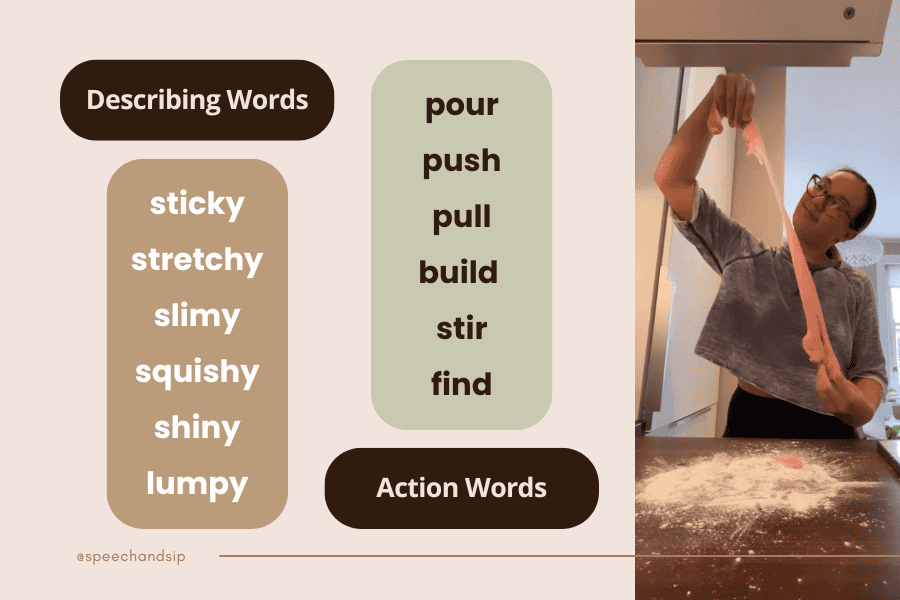
Mitigable Gestalts and Short Phrases
This Halloween activity also creates many opportunities to model mitigable gestalts and short phrases naturally. Gestalts are scripted language or chunks of language.
Related Post: Journey through the two ways to develop language

Have you tried…
Hide and Seek
After you’ve made this Halloween slime recipe, hide Halloween critters and objects in the slime. Use toy spiders, eyeballs, worms, skeletons, and witches. Take turns finding, labelling and describing each item you find. For example, “I found a spider… it has 8 hairy legs.”
Halloween Stories
Create stories about witches or wizards making potions. What will you put in the potion? and what happens when someone (pretends) to drink it?
Halloween Slime and Speech Sounds
Halloween is a superb season to model and practise s-cluster sounds. Here are a few to get you started:
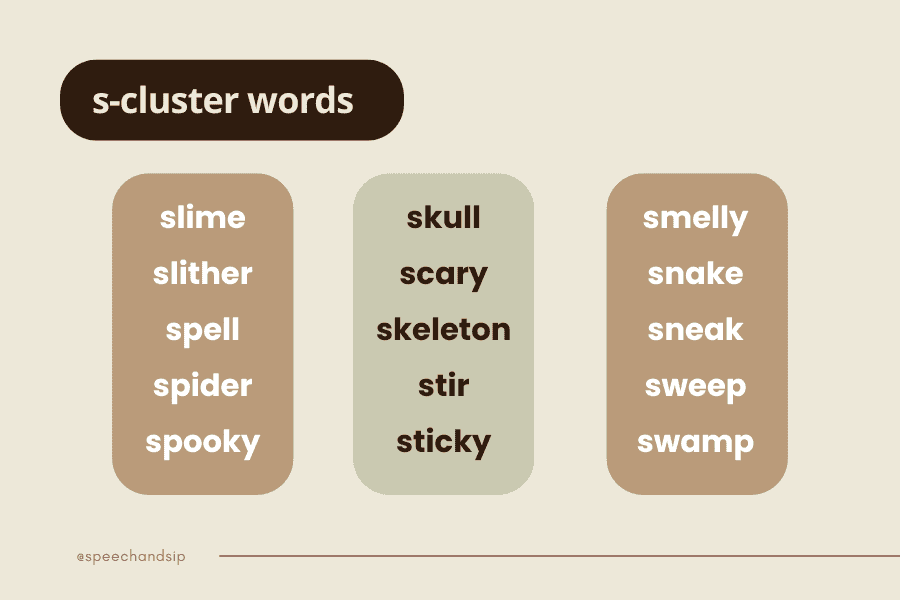
These are some speech and language suggestions to incorporate into this Halloween activity. Remember to follow your child’s lead in the interaction and model language before, during and after play. Will you be making this Halloween slime recipe this spooky season?


Leave a Reply